
Compose Multiplatform vs Flutter: Which Cross-Platform Framework Wins in 2026?
Why the Compose Multiplatform vs Flutter Decision Hits Harder in 2026
Core Architecture: Where Flutter's Impeller Engine and Compose's Kotlin-Native Approach Diverge
Developer Experience: Setup, Hot Reload, and the Real Time-to-First-Screen
Platform Coverage in Production: Where Each Framework Actually Ships
Total Cost of Ownership: Ecosystem Maturity, Native Bridging, and the Long Game
The Indie Developer's Decision Filter — Six Questions That Cut Through the Noise
Cost, Performance, and Time-to-MVP: The Numbers Behind the Tradeoff
Your Compose Multiplatform vs Flutter Decision Gate
Wait — I need to restart and produce the full HTML output, not just headings.
You've already decided cross-platform is the path. The friction now is choosing between two frameworks that both promise "ship once, run everywhere" — and the compose multiplatform vs flutter question has gotten harder, not easier, in 2026. Flutter holds roughly 46% adoption among cross-platform developers this year, while Kotlin Multiplatform (including Compose Multiplatform) sits at about 23%, according to PerfectionGeeks. Market share isn't the deciding factor. Your team composition, language fluency, and timeline are.
Here's what changed: with Compose Multiplatform for iOS hitting stable in 2025, KMP teams can now share ~85–90% of UI code across iOS and Android, per Shorebird's 2026 architecture guide. That closes the historical gap where Flutter shared everything and KMP shared only logic. The two camps are converging on capability — which means the choice now hinges on context, not features. By the end of this article, you'll have a decision rule, not a vendor pitch.
Table of Contents
- Why the Compose Multiplatform vs Flutter Decision Hits Harder in 2026
- Core Architecture: Where Flutter's Impeller Engine and Compose's Kotlin-Native Approach Diverge
- Developer Experience: Setup, Hot Reload, and the Real Time-to-First-Screen
- Platform Coverage in Production: Where Each Framework Actually Ships
- Total Cost of Ownership: Ecosystem Maturity, Native Bridging, and the Long Game
- The Indie Developer's Decision Filter — Six Questions That Cut Through the Noise
- Cost, Performance, and Time-to-MVP: The Numbers Behind the Tradeoff
- Your Compose Multiplatform vs Flutter Decision Gate
Why the Compose Multiplatform vs Flutter Decision Hits Harder in 2026
Three landscape shifts make this decision materially different from what it was in 2023 or 2024. If you're working from outdated framework comparisons, you're optimizing for a world that no longer exists.
Shift one: Compose Multiplatform for iOS stabilized in 2025. Until then, the KMP pitch had a structural weakness — you could share business logic across platforms, but you maintained two native UIs (SwiftUI on iOS, Compose on Android). That doubled UI work and split design system enforcement. With Compose Multiplatform now stable on iOS, that ceiling lifted. UI sharing climbs to ~85–90%, according to both Shorebird and PerfectionGeeks. The "Flutter shares everything, KMP shares only logic" framing is no longer accurate. Flutter's single structural advantage — one codebase, one UI — has been substantially neutralized.
Shift two: Flutter's adoption is plateauing. The 46% figure still leads the market by a wide margin, but the curve is flattening while KMP's 23% is climbing. Shorebird describes the meta-trend explicitly as convergence — Flutter is improving native feel through Impeller and refined widgets, while KMP is expanding UI sharing through Compose Multiplatform. Neither framework is collapsing. Both are moving toward each other, which means the choice between them becomes less about capability gaps and more about which set of trade-offs fits your context.
Shift three: the cost of guessing wrong has gotten more expensive. Brainic estimates Flutter ships MVPs 30–40% faster than KMP/Compose, but KMP is cheaper to maintain long-term because of its native-aligned architecture and direct platform API access. Translate that into a real scenario: an indie developer who picks Flutter to ship fast, then needs HealthKit, ARKit, or secure enclave integration in v2, pays the framework-swap tax — measured in months, not weeks. The inverse scenario stings just as badly. A Kotlin-fluent solo founder who picks Flutter "because everyone says so" loses 2–3 months learning Dart and the widget paradigm before writing a single feature.
The trade isn't symmetric. Flutter's ecosystem and onboarding speed are genuinely larger. KMP's long-term flexibility and native-integration ergonomics are genuinely deeper. The framework that "wins" depends entirely on which set of constraints you're optimizing against — your team's existing language fluency, your need for deep native APIs, your MVP timeline, and whether your backend already runs Kotlin.
That's the thesis of this article: this isn't "which framework is better" — it's "which framework matches your team's constraints, language familiarity, and timeline." Anyone telling you Flutter or Compose Multiplatform is objectively superior in 2026 is selling you something. The honest comparison requires you to know your own situation first.
The rest of this piece walks through the architectural, developer-experience, ecosystem, and cost dimensions you need to evaluate — with the data to back each call and a decision gate at the end you can apply to your own project today.
Core Architecture: Where Flutter's Impeller Engine and Compose's Kotlin-Native Approach Diverge
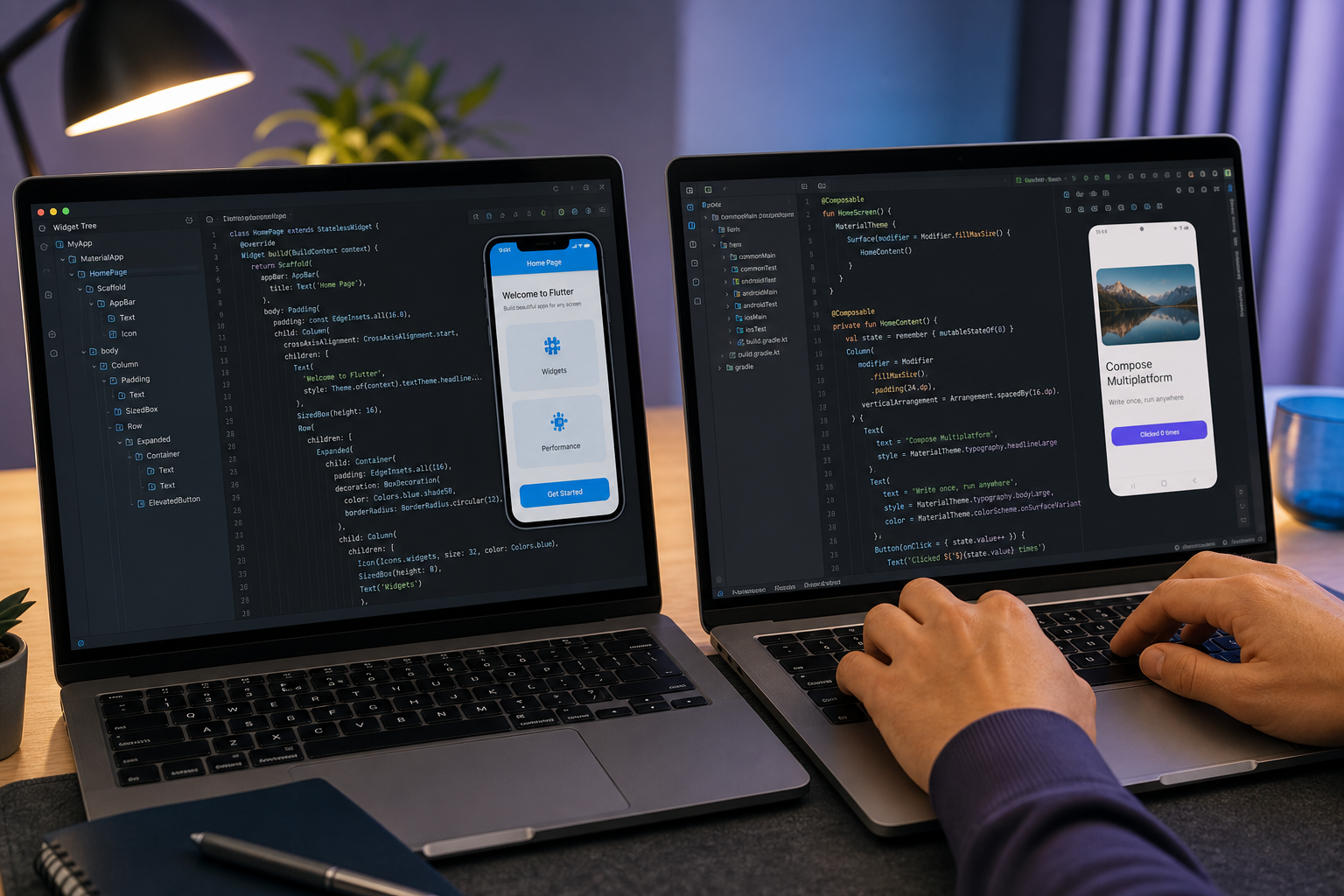
The architectural difference between these two frameworks is structural, not cosmetic. Flutter renders its own UI via the Impeller engine (which replaced Skia as the default renderer in Flutter 3.10, per Shorebird), drawing every pixel itself rather than handing off to native UI layers. Compose Multiplatform uses Kotlin to describe UI but integrates more closely with the underlying platform via the expect/actual pattern, giving compile-time typed access to native APIs (per PerfectionGeeks and Aetherius).
| Dimension | Flutter | Compose Multiplatform |
|---|---|---|
| Language | Dart (Flutter-only) | Kotlin (Android, backend, server) |
| UI rendering | Impeller engine renders every pixel | Kotlin UI integrated with native rendering |
| Platform abstraction | Platform channels (message-passing) | expect/actual (compile-time typed) |
| Code sharing scope | UI + logic, 80–95% shared | UI + logic, ~85–90% shared |
| Native interop friction | Plugin/channel indirection | Direct typed platform API access |
| Native feel | Custom widgets mimic native | Architecturally aimed at native feel |
Why does "Compose uses Kotlin" matter beyond a language preference? Any Android developer reading this already writes Kotlin every day. Onboarding cost to Compose Multiplatform is near-zero — the syntax, the Compose declarative model, the coroutines, all of it transfers. The same developer moving to Flutter learns Dart syntax, the widget tree paradigm, and a new state-management ecosystem (Provider, Riverpod, Bloc). That's weeks of degraded velocity before they're shipping at full speed.
Why does Flutter's self-rendering matter in practice? When Apple ships a new iOS design language or a new platform API, Flutter widgets need to catch up through the Flutter team's release cycle. Compose Multiplatform can call directly into the new native API via expect/actual on day one. That's a real difference if you ship apps that need to feel current with each OS release.
The counterweight: Flutter's self-rendering means visual consistency across platforms is easier. Your buttons look identical on iOS and Android out of the box because Flutter draws them itself. Compose Multiplatform requires more deliberate effort to either match each platform's native styling or enforce a custom design system across both. If pixel-perfect cross-platform parity is your priority, Flutter does less work for you to get there.
Architecture predicts your velocity, not your quality. Both frameworks ship production apps that real users pay for.
Developer Experience: Setup, Hot Reload, and the Real Time-to-First-Screen
The day-to-day developer experience is where these two frameworks feel most different — and where a lot of indie devs make their gut decision before evaluating the long-term math.
- Setup & Scaffolding Time. Flutter scaffolds a hello-world app via
flutter createin under a minute. Compose Multiplatform's out-of-box scaffolding via the Kotlin Multiplatform Wizard is heavier — multiple Gradle targets, expect/actual stubs, platform-specific entry points, separate iOS and Android app shells. This is where production-ready boilerplate solutions like KMP Kit reclaim the gap, bundling authentication, in-app purchases, push notifications, and a design system pre-configured — saving 122+ hours versus wiring it all manually. - Hot Reload Speed. Flutter's hot reload remains the gold standard. Sub-second UI updates while preserving state, consistently fast, rarely breaks. Compose Multiplatform's hot reload has improved significantly with the JetBrains tooling roadmap but still trails Flutter in raw speed for UI iteration, per Shorebird. If you're doing UI-heavy prototyping and iterating on visual design dozens of times an hour, Flutter still wins this round meaningfully.
- Debugging Cross-Platform Surprises. Flutter's "works on iOS, fails on Android" issues often surface through plugin or platform-channel mismatches at runtime — debug, reproduce, patch, repeat. Compose Multiplatform's expect/actual pattern makes platform-specific code compile-time explicit. You think upfront about what differs per platform, which trades runtime surprises for more deliberate architecture work, per PerfectionGeeks.
- Hiring & Team Onboarding. Flutter's developer community is larger (~46% adoption vs. ~23% for KMP), translating to a deeper hiring pool when you scale. But for shops already running Kotlin (Android team, server-side Spring or Ktor, Gradle build infrastructure), Compose Multiplatform means zero language onboarding. The net hiring math depends on your existing stack — pool depth only matters if you're recruiting from outside your current team's skillset.
- Learning Curve for Android Developers. An Android dev jumping to Flutter learns Dart syntax, the Flutter widget tree, and state management patterns — typically 4–6 weeks to productive output, per PerfectionGeeks and Codigee. The same dev moving to Compose Multiplatform writes the same Jetpack Compose code they already know, with KMP architecture concepts (source sets, expect/actual, Gradle targets) layered on top — typically 1–3 weeks. The gap is real and quantifiable.
- IDE Tooling. Flutter is well-supported in both VS Code and Android Studio with the Flutter plugin. Compose Multiplatform is best-in-class inside JetBrains IDEs (IntelliJ IDEA, Android Studio with the KMP plugin) and marginal in VS Code. For a one-person team that lives in their IDE eight hours a day, that daily-friction difference is worth weighing honestly.
Platform Coverage in Production: Where Each Framework Actually Ships
Both frameworks claim broad reach. The honest question isn't "how many platforms does it support?" but "how many does it support in production at a quality level you'd ship to paying users?"
| Platform | Flutter Maturity | Compose Multiplatform Maturity |
|---|---|---|
| Android | Stable, production-proven | Stable, production-proven |
| iOS | Stable, production-proven | Stable since 2025 |
| Web | Stable, plugin gaps for heavy apps | Experimental → stabilizing |
| Desktop (Win/macOS/Linux) | Stable | Stable on macOS/Windows; Linux improving |
| Wearables (Wear OS / watchOS) | Limited / community plugins | Cautious / not primary focus |
| Embedded / IoT / TV | Supported, fragmented in practice | Not a primary target |
Codigee and PerfectionGeeks both note a critique worth taking seriously: Flutter's broader platform coverage is often more theoretical than practical. Teams rarely need 5–6 platforms in production, and many of the non-mobile targets remain less mature than the iOS and Android implementations. The marketing surface ("Flutter targets six platforms") and the production surface ("can I actually ship a polished web build with full plugin support?") aren't the same thing.
Brainic adds a sharper point: apps needing deep hardware integration — NFC, Bluetooth, HealthKit, ARKit, secure enclave, advanced media APIs — often benefit from native or KMP over Flutter because of platform-channel indirection. Every time you cross the Dart-to-native boundary through a plugin, you add latency, boilerplate, and a dependency on whoever maintains that plugin (per Brainic). Compose Multiplatform's expect/actual gives you direct typed access — no plugin maintainer in the middle of your hardware integration.
The honest framing: if you're shipping a content-driven consumer app and you genuinely need web and desktop builds from the same codebase, Flutter's broader maturity matters. If you're shipping iOS and Android only — which describes 80%+ of indie projects in practice — Compose Multiplatform's narrower focus is a feature, not a limitation. You're not paying complexity tax for platforms you'll never target.
A concrete example: a solo founder building a fitness app needs HealthKit on iOS, Health Connect on Android, secure storage for tokens, and push notifications. Compose Multiplatform's direct platform API access lets that founder bridge each platform cleanly without waiting on a plugin maintainer to keep up with iOS releases. Flutter can do the same job — but the path runs through someone else's plugin, and you inherit their roadmap.
Total Cost of Ownership: Ecosystem Maturity, Native Bridging, and the Long Game
Total cost of ownership is where this comparison gets uncomfortable for both camps. Flutter has a clear short-term cost advantage. Compose Multiplatform has a clear long-term flexibility advantage. Sorting which one matters more for your project requires looking at five dimensions honestly.
Library ecosystem size. Flutter's pub.dev hosts 30,000+ packages in 2026, per PerfectionGeeks, spanning every common mobile need — payments, auth, maps, analytics, media, sensors. Compose Multiplatform relies on the broader Kotlin ecosystem: Ktor for networking, Koin for dependency injection, kotlinx.serialization, kotlinx.coroutines, Coil for image loading. The Kotlin ecosystem is mature and deep on backend and logic, but mobile-specific packages — especially platform integrations for niche features — are fewer and require more manual bridging, per Aetherius. That's a real gap if your app depends on a long tail of third-party services.
Native interop friction. Flutter uses platform channels — asynchronous message-passing between Dart and native (Swift/Kotlin) code. It works, but it adds boilerplate and a runtime debugging surface. Compose Multiplatform uses expect/actual — compile-time typed access to platform APIs. More elegant, but it requires you to understand KMP source set structure (commonMain, androidMain, iosMain) before you start. The counter-evidence is honest: Brainic notes some Flutter plugins for deep native functionality lag behind OS features, which erodes the one-codebase promise the moment you hit an edge case that the plugin maintainer hasn't kept current with.

Production feature parity — auth, payments, push. Both frameworks have solutions for Firebase authentication, RevenueCat in-app purchases, and FCM/APNS push notifications. Flutter has more pre-packaged plugins available immediately. Compose Multiplatform requires more manual bridging unless you start from a pre-built foundation. Reference KMP Kit's feature set as the concrete example: it ships authentication (Apple, Google, Email), in-app purchases and subscriptions, push notifications, CI/CD pipelines, a design system, local database, and networking pre-integrated. That collapses the "Compose Multiplatform has a smaller mobile ecosystem" critique into a narrower truth: it has a smaller ecosystem unless you start with the right boilerplate.
Language leverage beyond mobile. Dart is essentially single-purpose — used almost exclusively for Flutter. Kotlin is used for Android native development, JVM backend (Spring, Ktor server), Gradle build scripts, server-side scripting, and multiplatform mobile. If your team writes a Kotlin backend, your data models, validation logic, and serialization code reuse directly into the mobile app via shared KMP modules. With Flutter, your backend and mobile app live in separate language worlds — you re-serialize, re-validate, re-test the same domain logic in two languages, per PerfectionGeeks and Brainic. Over a multi-year product lifecycle, that's substantial compounded effort.
Long-term framework risk. Shorebird and PerfectionGeeks both frame the long-term picture honestly. Flutter's risk is momentum plateau and dependence on Google's prioritization — the framework is healthy, but Google's track record on framework sustainment is mixed. KMP/Compose's risk is lower because it's backed by both JetBrains (Kotlin's creators) and Google, and Kotlin's growth as a general-purpose language insures the language itself — even if specific UI frameworks evolve or get replaced, Kotlin code isn't stranded.
Flutter's larger ecosystem is irrelevant if the only libraries you need — auth, payments, push, networking — are already pre-wired into your starter kit.
The Indie Developer's Decision Filter — Six Questions That Cut Through the Noise
Frameworks aren't evaluated in the abstract. They're evaluated against your specific situation. Run your project through these six questions before you commit.
- Does your team already write Kotlin (Android, backend, or both)? If yes → Compose Multiplatform compounds existing knowledge. An Android dev hits productivity on Compose Multiplatform in 1–3 weeks versus 4–6 weeks learning Dart and Flutter widgets, per PerfectionGeeks. If you have no Kotlin experience anywhere on the team → Flutter's simpler syntax and faster onboarding may genuinely save weeks. Pick the framework that doesn't make you pay a language tax.
- Is your scope iOS + Android only, or do you also need web, desktop, or embedded targets? iOS + Android only → Compose Multiplatform's focused maturity is enough, and you avoid carrying complexity for platforms you'll never ship. Web, desktop, and embedded as production-critical requirements (not aspirational nice-to-haves) → Flutter's broader stable coverage wins materially. Be honest with yourself: do you actually need that sixth platform, or does it just sound good in your pitch deck?
- What's your MVP timeline — 4–8 weeks or 3–6 months? 4–8 weeks with experienced Flutter developers available → Flutter's 30–40% MVP speed advantage matters and you should take it, per Brainic. 3–6 month horizon → Compose Multiplatform's long-term maintenance economics outweigh upfront speed. Or compress both: use a Compose Multiplatform boilerplate like KMP Kit to cut KMP setup by 122+ hours and land closer to Flutter's MVP timeline without sacrificing the long-term architecture.
- Do you need deep native integration — HealthKit, ARKit, NFC, secure enclave, Bluetooth, advanced media APIs? Yes → Compose Multiplatform's direct platform API access through expect/actual beats Flutter's platform-channel indirection, per Brainic. You skip the plugin-maintainer dependency entirely. No, mostly REST APIs and standard mobile features (camera, basic location, notifications) → either framework handles your needs without friction.
- Are you planning a Kotlin backend or already running one? Yes → Compose Multiplatform lets you share data models, validation logic, and serialization code between server and mobile via shared KMP modules. That's a substantial long-term win that compounds over every release. No backend, or backend in Node, Python, Go, or another stack → this advantage doesn't apply, and Flutter's other strengths weigh more.
- Are you optimizing for hiring at scale or shipping solo / small-team? Hiring at scale across 10+ engineers → Flutter's larger talent pool (46% vs. 23% adoption) is a real recruiting advantage you'll feel every hiring cycle. Solo or 2–3 person team with existing Kotlin skills → pool size is irrelevant; team fit and existing fluency dominate the math.
If you pass 3+ of these checks toward Compose Multiplatform, the math favors it strongly. If you pass 3+ toward Flutter, the math favors Flutter strongly. If you're split 3-3, the decision is genuinely close — and at that point, the tie-breaker is usually whichever framework your most senior developer enjoys more, because morale and momentum on a small team are worth more than a theoretical 20% efficiency gain.
Cost, Performance, and Time-to-MVP: The Numbers Behind the Tradeoff
Vendor blogs disagree on specifics, but the directional consensus across PerfectionGeeks, Brainic, and Shorebird is consistent: Flutter is faster and cheaper upfront, KMP/Compose is cheaper to maintain long-term and gets closer to native performance characteristics.
| Dimension | Flutter | Compose Multiplatform |
|---|---|---|
| Time-to-MVP (content app) | 4–8 weeks | 3–6 months |
| Cost vs. native baseline | 40–50% cheaper | 25–35% cheaper |
| MVP speed advantage | 30–40% faster than KMP | Baseline |
| Code sharing | 80–95% | 85–90% |
| Startup time | Good | Identical to native |
| Memory usage | Moderate to high | Optimal |
| Animation performance | Excellent (60/120fps) | Excellent (60/120fps) |
| App ratings signal | ~4.2★ (Flutter apps) | ~4.5★ (enterprise KMP apps) |
Flutter wins the sprint. Compose Multiplatform wins the marathon. The right question is which race you're actually running.
These numbers come from agency and vendor blogs, not peer-reviewed studies — treat them as directional rather than definitive. PerfectionGeeks and Brainic both flag this methodology caveat explicitly, and you should carry it forward when you cite any of these figures internally.
The rating gap deserves nuance. The ~4.2★ vs ~4.5★ delta (Appfigures data cited by PerfectionGeeks) is small in absolute terms but real if it correlates with App Store ranking and conversion. PerfectionGeeks attributes the KMP advantage to native-feel UX, especially on iOS, where users notice non-native scrolling physics and animation curves. The sample bias matters too — "enterprise KMP apps" versus "all Flutter apps" isn't a clean comparison, and the populations differ in ways that confound the rating signal. Don't treat 4.5★ as a guaranteed outcome.
Time-to-MVP economics flip on team composition. Flutter's 4–8 week advantage is real if your team already knows Dart. For a Kotlin-experienced team, the gap inverts — they hit MVP faster in Compose Multiplatform because they skip the language and widget-paradigm curve entirely. Boilerplate kits compress this further: a Compose Multiplatform starter with auth, payments, push, and CI/CD pre-wired (roughly 122+ hours saved) lands you close to Flutter's MVP timeline without sacrificing the long-term maintenance economics.
Cost framing needs the same nuance. Brainic's 40–50% cheaper than native for Flutter versus 25–35% cheaper for KMP looks decisive on paper — until you factor in the framework-switch cost when you outgrow Flutter's plugin ecosystem or hit platform-channel debugging walls. KMP's smaller stated cost advantage compounds over years of maintenance; Flutter's larger advantage front-loads into the first six months and then erodes if your app pushes into territory the ecosystem doesn't cover well.
Performance, honestly assessed, is rarely the deciding factor. For typical business apps — content, commerce, SaaS, social — all three options (Flutter, KMP/Compose, fully native) hit 60/120fps reliably. Performance only becomes decisive when you're building games, video editors, AR experiences, or something else that pushes the platform's limits. For 95% of indie projects, this row of the table doesn't move the decision.
Your Compose Multiplatform vs Flutter Decision Gate
Don't pick a framework. Pick a decision rule. Run your project through the gates below. If you fail more than one Compose Multiplatform check, Flutter is probably your faster path. If you pass three or more, Compose Multiplatform is the higher-leverage bet — and a boilerplate kit closes the remaining setup-time gap.
| Your Situation | Pick Flutter If… | Pick Compose Multiplatform If… |
|---|---|---|
| Team language | No Kotlin experience; ready to learn Dart | Already write Kotlin (Android, backend, or both) |
| Platform scope | Need web + desktop + embedded as core | iOS + Android (+ optional desktop) is enough |
| Timeline | MVP must ship in 4–8 weeks with Flutter devs | 3–6 month horizon, or use a KMP boilerplate |
| Native depth | Mostly REST + standard mobile features | Need HealthKit, ARKit, NFC, secure enclave |
| Backend stack | Node, Python, Go, or no backend overlap | Kotlin/JVM backend exists or is planned |
| Hiring strategy | Hiring at scale; talent pool depth matters | Solo or small team with Kotlin fluency |
The Three-Gate Test.
Gate 1 — Language. Does your team write Kotlin today? If yes, strongly prefer Compose Multiplatform. The compounding effect of every developer on your team already being fluent in the framework's language is hard to overstate. If no Kotlin experience anywhere, Flutter has the lower onboarding tax and you should take it — the learning curve to Dart is meaningfully shorter than the curve to Kotlin plus KMP source-set architecture.
Gate 2 — Scope. Are iOS and Android your only must-ship platforms? If yes, Compose Multiplatform's focused maturity is sufficient and gives you the native-quality UX that the ~4.5★ vs ~4.2★ signal (per PerfectionGeeks/Appfigures) hints at. If you need web and desktop as production-critical targets — not aspirational ones — Flutter's broader stable coverage wins this gate cleanly.
Gate 3 — Setup Time. Will the KMP setup overhead kill your MVP timeline? Solve it directly rather than abandoning the framework choice. A production-ready Compose Multiplatform boilerplate ships pre-integrated authentication, in-app purchases, push notifications, design system, networking, and CI/CD — saving roughly 122+ hours and erasing Flutter's setup-speed edge. Three pricing tiers — Discover (free), MVP ($169), Scale ($349) — map to project maturity from validation through scale.
If you write Kotlin and ship to iOS and Android, Compose Multiplatform plus a production boilerplate is the shortest path from idea to production. If you don't write Kotlin, Flutter is still the safer bet.